
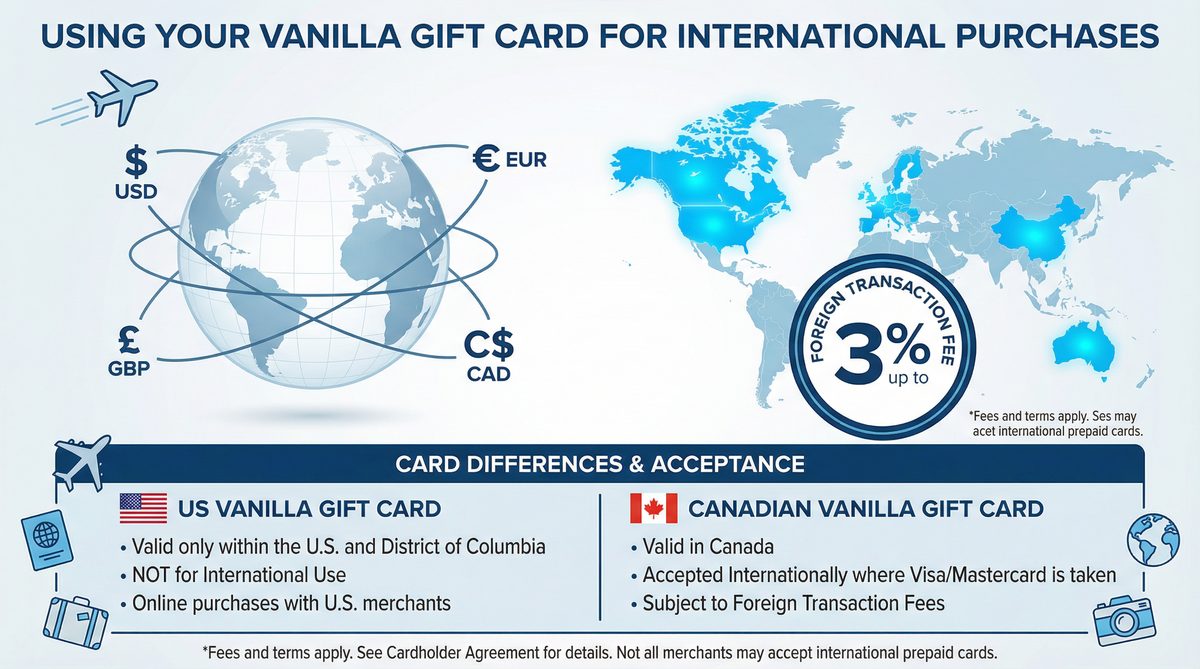
Gift cards have become a popular option for giving gifts with flexibility, and Vanilla gift cards stand out as one of the leading options on the market. However, when it comes to international use, many questions arise about restrictions, fees, and supported currencies. This article aims to clarify everything you need to know about using your Vanilla gift card for purchases outside the United States and Canada, focusing on the differences between cards issued in both countries.
Vanilla gift cards are prepaid cards, often of the Visa or Mastercard type, and can be used anywhere these networks are accepted. They offer great convenience as they don't require a bank account or credit check. However, their prepaid nature means they have certain limitations, especially regarding international use.
For most Vanilla gift cards issued in the United States, usage is generally restricted to within the United States and the District of Columbia [1] [2] [3]. This means if you received a Vanilla gift card in the United States, you're unlikely to be able to use it to make purchases in Canada or any other country. This restriction is usually mentioned in the terms and conditions printed on the card or in the cardholder agreement.
These restrictions are imposed for regulatory and security reasons. Anti-Money Laundering (AML) and Counter-Terrorism Financing (CTF) laws differ from country to country, making it difficult for gift card issuers to ensure compliance when cards are used across borders. Additionally, exchange rate differences and fees associated with international transactions can complicate matters.
In contrast, Vanilla prepaid cards (Vanilla Prepaid Mastercard or Visa) issued in Canada are often more flexible regarding international use [4] [5]. These cards can be used anywhere Mastercard or Visa is accepted, including international locations. However, there's an important consideration to keep in mind: foreign transaction fees.
If you use a Canadian Vanilla prepaid card to make a transaction in a foreign currency (i.e., not Canadian dollars), a foreign exchange fee will be applied. These fees typically amount to about 2.5% of the transaction value [6] [7]. These fees are similar to those charged by most Canadian banks on their credit and debit cards when making international transactions.
Given the differences between cards, it's always necessary to check the terms and conditions of your Vanilla gift card or prepaid card before attempting to use it internationally. Here's how to do it:
If your Vanilla gift card doesn't support international use, or if you want to avoid foreign transaction fees, there are several alternatives you can consider:
| Feature | Vanilla Gift Card (United States) | Vanilla Prepaid Card (Canada) |
|---|---|---|
| International Use | Restricted (usually only within the United States and DC) [1] [2] [3] | Possible (anywhere Mastercard/Visa is accepted) [4] [5] |
| Foreign Transaction Fees | Not applicable (due to usage restrictions) | Approximately 2.5% of transaction value [6] [7] |
| Supported Currencies | US Dollar only | Canadian Dollar + Foreign currencies (with fees) |
| Balance Verification | Online or by phone | Online or by phone |
No, Vanilla gift cards issued in the United States are usually restricted to use only within the United States and the District of Columbia [1] [2] [3].
Yes, Canadian Vanilla prepaid cards charge foreign transaction fees of approximately 2.5% of the transaction value [6] [7].
You should read the terms and conditions printed on the back of your card or review the cardholder agreement online. You can also contact customer service for clarification.
Alternatives include traditional credit/debit cards, prepaid travel cards, online payment services like PayPal or Wise, and merchant-specific gift cards.
If your card is restricted to use within the United States, it won't work even for online purchases from international websites. If it's a Canadian prepaid card, it can be used online but foreign transaction fees may apply.
In conclusion, while Vanilla gift cards offer great convenience for domestic purchases, using them for international purchases requires a careful understanding of restrictions and fees. US cardholders should expect restrictions on international use, while Canadian cardholders can use their prepaid cards internationally with foreign exchange fees. Always verifying your card's terms and conditions is the most important step to ensure a smooth shopping experience.